
Your card declines at the grocery checkout. Your benefits don’t show up. Your account is suddenly “under review,” or a letter arrives announcing a decision you didn’t know was being made.
This pattern is familiar. The change is instant; repair sits behind hold music, web forms, “high volume,” and a promise that someone will look at it.
Power used to look like “a decision maker.” Now it looks like an undo button you don’t get to press.
Our political center of gravity has to move from who makes the decision to how hard the decision is to reverse.
Fast harm, slow repair
Systems can change your status in real time. Repair happens on human time by shifting the labor to you.
Healthcare proves the cost of delay in biological terms. The funnel, denial to appeal to reversal:
19%
Denied
of in-network claims, ACA marketplace insurers, 2023 — roughly 1 in 5.
<1%
Appealed
of tens of millions of denials.
44%
Overturned on appeal
at least partially, when people do appeal.
80%+
Prior-auth appeals that succeed
in some studies.
The system can sustain a 19% denial rate because fewer than 1% of consumers appeal, even though 44% of appeals reverse a denial at least in part.
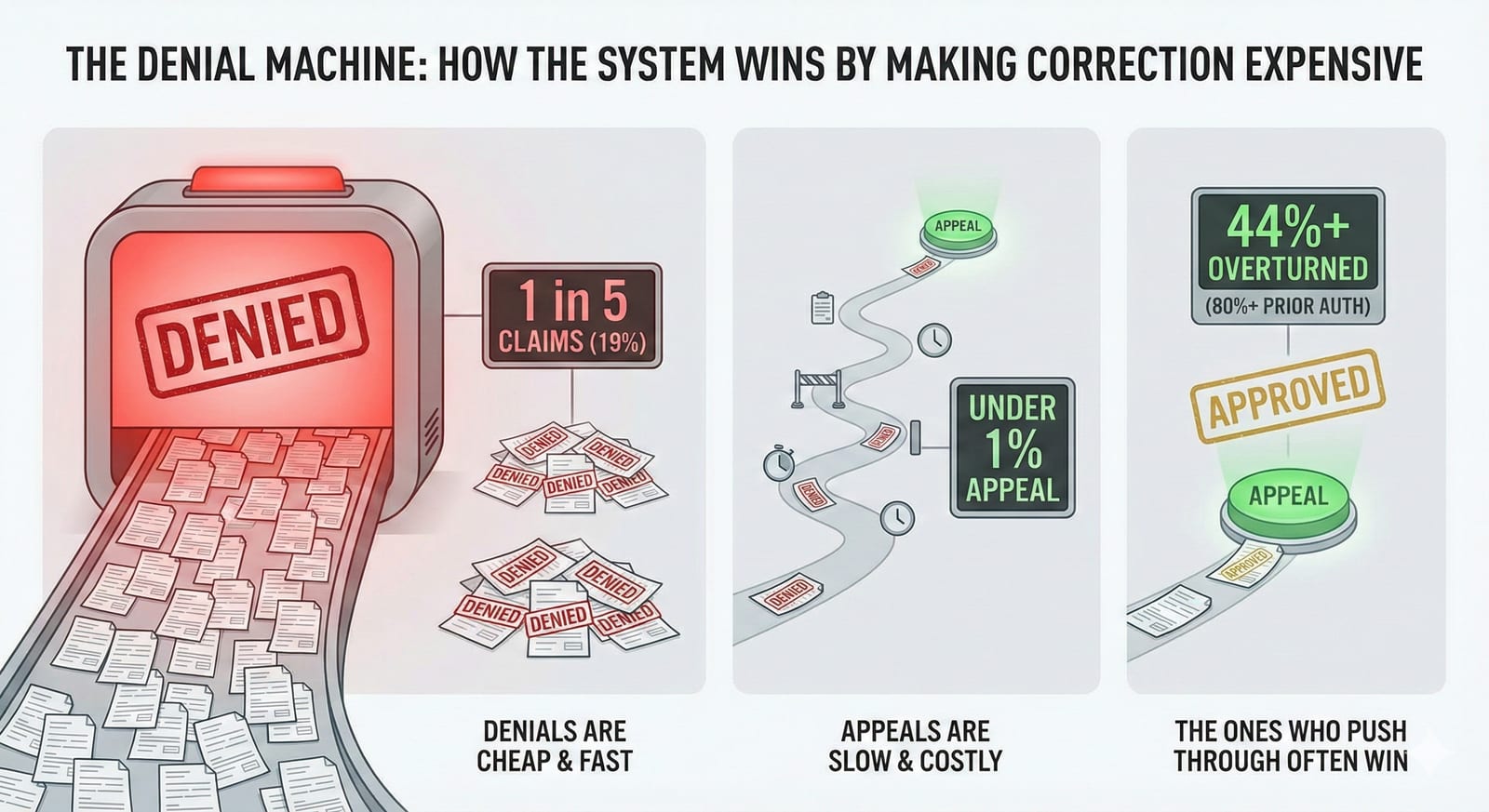
Which means the system doesn’t win by being right. It wins by making correction expensive enough that most people can’t afford to try.
Denials are cheap and fast. Appeals are slow and costly — in time, energy, uncertainty, and risk.
In the Age of Appeals, persistence reverses decisions the system was willing to leave wrong.
The pattern outside healthcare
I see this structure everywhere:
| Domain | Harm speed | Repair speed | Is enforcement stayed while you appeal? |
|---|---|---|---|
| Benefits | Payments stop overnight. | Hearing dates land months later. Pennsylvania unemployment appeals can run 2–6 months. | No. You still need rent and groceries during "the process." |
| Housing | The move from filing to removal can be weeks. Illinois eviction cases can reach hearing in 7 days. | An appeal. | No. Filing an appeal does not automatically stay enforcement, so the right to appeal can survive the loss of the home. |
| Platforms | A flag can erase an account and income instantly. | "Review" has no binding timeline and can stretch to "weeks or months." | No binding stay. The platform decides if you get your life back — and when. |
| Immigration | Removal and detention can move quickly. | The system that hears contests is backlogged for years. | — The right to contest exists inside a machine designed to outpace it. |
The new class divide is “error survivability”
In a high-speed administrative world, class is measured in error survivability: who can absorb or reverse a wrong decision before their life comes apart.

Who can afford to:
- Sit on hold for two hours on a Tuesday without getting fired
- Write in institutional jargon without melting down
- Front money while “it gets sorted out”
- Keep backup accounts, backup housing, backup childcare
- Pull in a lawyer, union rep, or journalist who gets a response
- Remain functional while their status is “pending”
That list describes procedural wealth: insurance against being wrongly flagged, fluency in procedure, and enough slack to spend a working week arguing with a bureaucracy.
A formal right behaves like a safety net for some and a dare for others.
Why the usual fixes miss
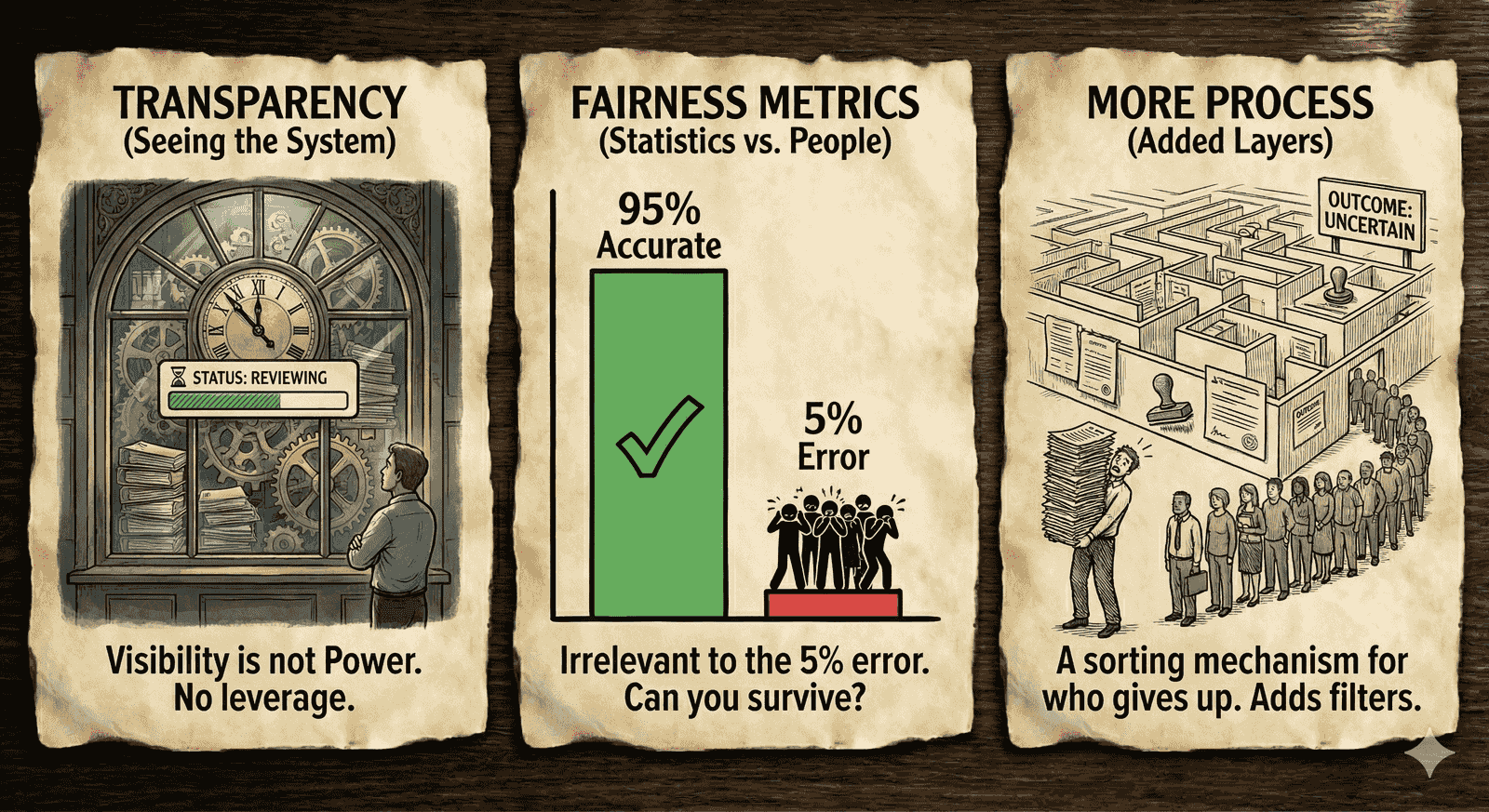
- Transparency: You can see the policy, understand the reason code, watch the status bar — and still have no leverage. Visibility is not power.
- Fairness metrics: A system can be “95% accurate” and still concentrate its errors on the people least able to contest them. For the person in the 5%, the metric is irrelevant. The question is: can you survive the mistake?
- More process: extra forms and extra layers add more filters for time, literacy, and stamina. Without binding timelines and real outcomes, process sorts for who gives up.
All of these change how systems talk about themselves without changing what they can be forced to do.
Repair that works
- Automatic stays for survival stakes. If an appeal is active, harm should not proceed for money-for-food, housing, essential medical care, or physical presence in a country. Default to continuity until someone with real authority resolves it.
- Binding deadlines with teeth. Pick numbers (14 days, 30 days). Enforce them. Missing the deadline shouldn’t be a “service failure” — it should trigger reversal, or a penalty the institution can feel.
- Burden on the actor. If a system flips your status, it should carry the burden of proving it was right — rather than forcing you to prove it was wrong while you’re under duress.
- Proportional capacity. If you can act on 100,000 people/day, you must be able to process 100,000 appeals/day within guaranteed timelines. Otherwise “you can appeal” is brochure text.
- Cost-shifting when wrong. When the institution is wrong, it should pay the person’s costs (fees, lost wages where applicable, and recognition of harm caused by delay). Right now almost all costs sit on the individual.
None of this requires believing institutions are evil. It requires refusing to let them be careless for free.
Rights require machinery
A right isn’t a sentence on paper. A right is the machinery that moves when the sentence is violated.
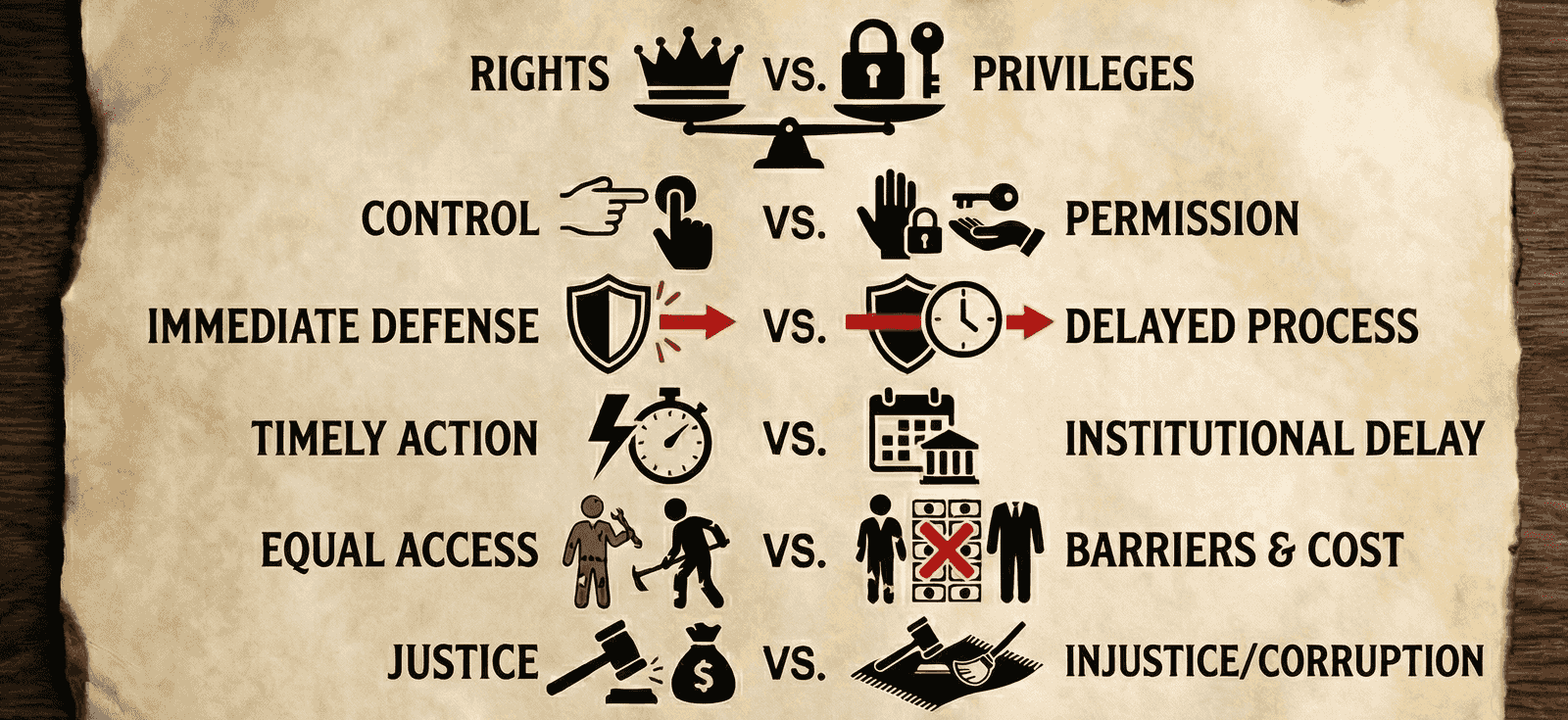
Ask:
- Can you trigger it yourself, or do you need permission?
- Does it stop harm while it runs, or does harm continue during review?
- Is there a binding deadline, or just a vague promise?
- Who bears the cost of the delay?
- When the system is wrong, what changes?
If the answer to most of these is “you’ll have to wait and see,” then you don’t have a right. You have a brochure.